



bajes [baɪɛs] is a Python software for Bayesian inference developed at Friedrich-Schiller-Universtät Jena and specialized in the analysis of gravitational-wave and multi-messenger transients. The software is designed to be state-of-art, simple-to-use and light-weighted with minimal dependencies on external libraries.
bajes is compatible with Python v3.7 (or higher)
and it is built on modules that can be easily installed via pip.
The mandatory dependencies are numpy, scipy and astropy.
However, the user might need to download some further packages.
See INSTALL for more information.
bajes provides an homonymous Python module that includes:
bajes.inf: implementation of the statistical objects and Bayesian workflow,bajes.obs: tools and methods for data analysis of multi-messenger signals. For more details, visitgw_tutorial.
The bajes package provides a user-friendly interface capable to easily set up a Bayesian analysis for an arbitrary model. Providing a prior file and a likelihood function, the command
python -m bajes -p prior.ini -l like.py -o /path/to/outdir/
will run a parameter estimation job, inferring the properties of the input model.
For more details, visit inf_tutorial
or type python -m bajes --help.
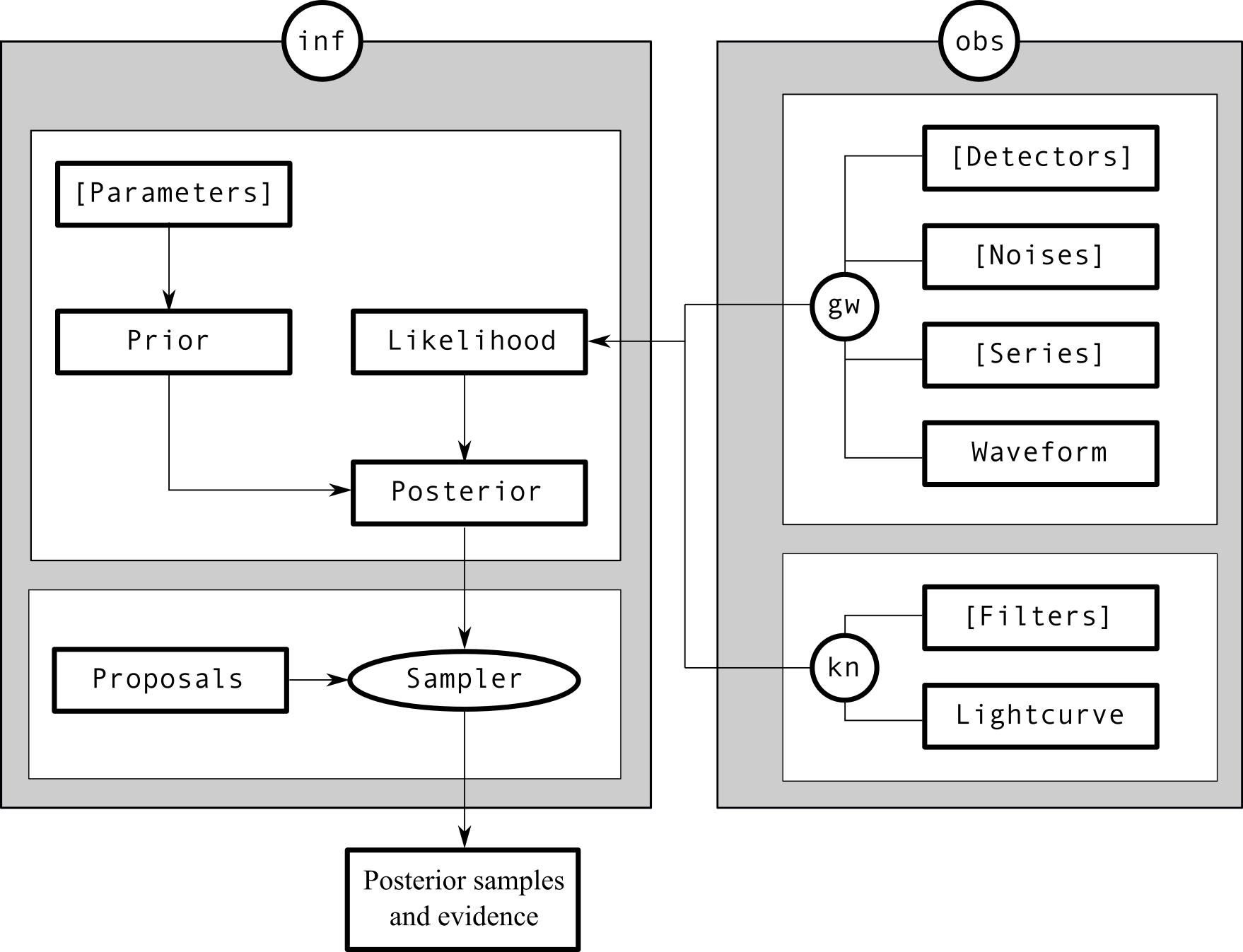
The bajes infrastructure allows the user to set up a pipeline for parameters estimation of multi-messenger transients. This can be easily done writing a configuration file, that contains the information to be passed to the executables. Subsequently, the following command,
bajes_pipe config.ini
will generates the requested output directory, if it does not exists, and
the pipeline will be written into a bash executable (/path/to/outdir/jobname.sub).
For more details, visit conifg_example.
The GW pipeline incorporates an interface with reduced-order-quadratude (ROQ) interpolants.
In particular, the ROQ pipeline relies on the output provided by JenpyROQ.
bajes is developed at the Friedrich-Schiller-Universität Jena,
visit CREDITS for more details.
If you find bajes useful in your research, please include the following citation in your publication,
@article{Bajes:2021,
         author = "Breschi, Matteo and Gamba, Rossella and Bernuzzi, Sebastiano",
         title = "{Bayesian inference of multimessenger astrophysical data: Methods and applications to gravitational waves}",
         eprint = "2102.00017",
         archivePrefix = "arXiv",
         primaryClass = "gr-qc",
         doi = "10.1103/PhysRevD.104.042001",
         journal = "Phys. Rev. D",
         volume = "104",
         number = "4",
         pages = "042001",
         year = "2021"
        }
bajes has benefited from open source libraries, including the samplers,
and the gravitational-wave analysis packages,
We also acknowledge the LIGO-Virgo-KAGRA Collaboration for maitaining the GWOSC.


